26 - Mathematics M1.SE.2 - Set Operations & Notation
⭐ +265 XP- ✓determine elements in intersections, unions and complements of sets
- ✓describe relationships among sets using set notation and symbols (universal, complement, subsets, equal, equivalent, intersection, disjoint, union)
- ✓apply the result n(A ∪ B) = n(A) + n(B) − n(A ∩ B)
⏱ 0 mins🎯 53 marks
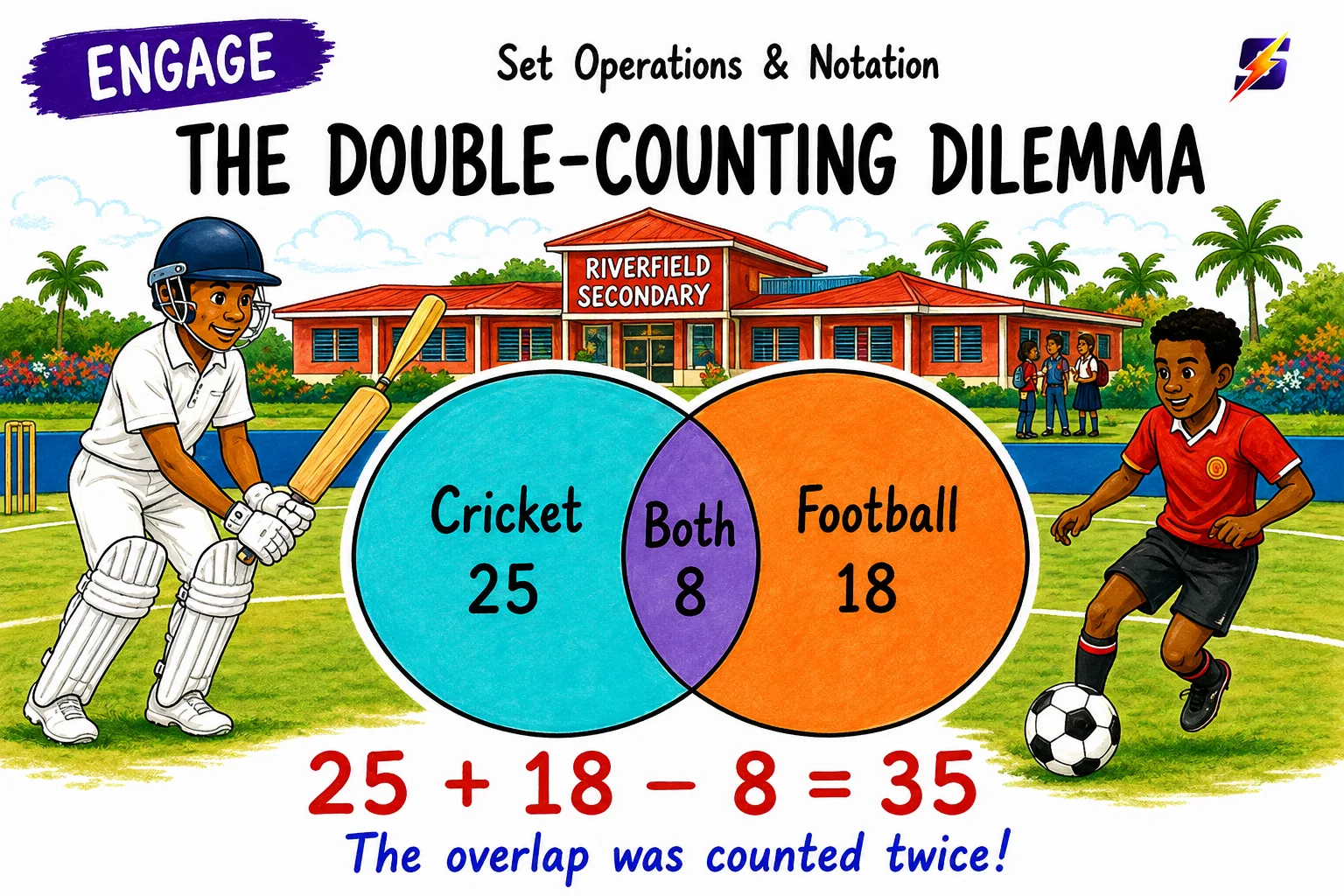

Engage
At a Trinidad school, 25 students play cricket and 18 play football. Surely 25 + 18 = 43 students total? But the principal counts only 35! What about the 8 who play BOTH? That's where set OPERATIONS come in, particularly the formula n(A∪B) = n(A) + n(B) − n(A∩B). Memory Hook / Mnemonic: U-I-C. Union, Intersection, Complement, the three big set operations.
1 / 4
← swipe to move between steps →
0%
Lesson progress0 / 53 marks
✓ 0 correct✕ 0 mistakes0 / 31 answered
Let's get started, you've got this! 💪